Guitar as Sequencer
Recently, I've been exploring the potential of treating the guitar as a kind of sequencer: using the left hand to pre-program notes, and the right hand to sequence them.
Gale (Emma Harner)
The tune 'Gale' by Emma Harner is a good example of what I mean. The full track seems to be unreleased, but there's a snippet of it in her 'guitar moves' interview:
Emma uses a combination of delicate open chords and complex right-hand picking patterns to create a rich, shimmering texture on the guitar. First I'll break down the parts, then I'll show how I made a Max for Live patch to emulate the technique.
left hand
This tune takes full advantage of DADGAD tuning, leaving very little to do for the left hand:
Chords:
                Dmaj7(add11)        E7sus2(add4)         Gmaj(add9)
D (1st) |---------0--------------------0----------------------0----
A (2nd) |---------4--------------------4----------------------7----
G (3rd) |---------0--------------------0----------------------0----
D (4th) |---------4--------------------4----------------------7----
A (5th) |---------0--------------------2----------------------5----
D (6th) |---------0--------------------2----------------------5----
right hand
The right hand is much more complicated. In this case, you pluck one finger at a time, then move your anchor position up by one, until you get to the top where you then do the entire thing in reverse.
Ascending:
D|----|----|---x
A|----|---x|--x-
G|---x|--x-|-x--
D|--x-|-x--|x---
A|-x--|x---|----
D|x---|----|----

Descending:
D|x---|----|----
A|-x--|x---|----
G|--x-|-x--|x---
D|---x|--x-|-x--
A|----|---x|--x-
D|----|----|---x
First of all, I think 'high E = 6th' string is silly. I prefer to zero-index from the lowest string up. With that in mind, the ascending pattern becomes:
[0,1,2,3, 1,2,3,4, 2,3,4,5]
which is basically "use all the fingers, then move the anchor and repeat". This can be quite neatly put as a list comprehension in python:
[ fingers + anchor for anchor in range(num_strings - num_fingers + 1) for fingers in range(num_fingers) ]
When num_fingers = 4 and num_strings = 6, this becomes:
[ finger + anchor for anchor in range(3) for finger in range(4) ]
Then we just travel backwards for the descending part.
the patch
I came up with this little patch in the process. I called it GALE: Guitar-Adjacent (e)Lectronic Expression (or Guitar Automation via List Expansion).
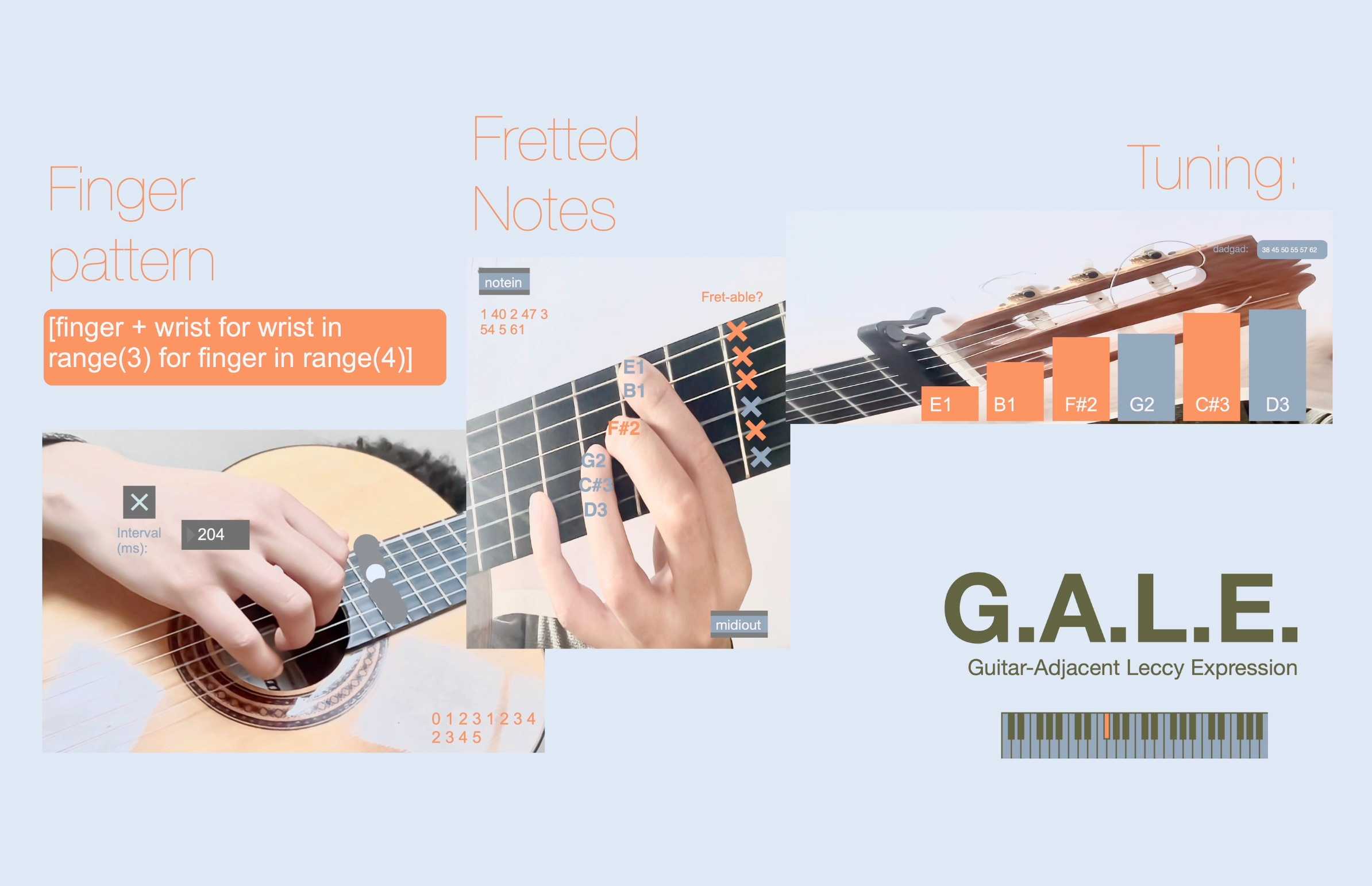
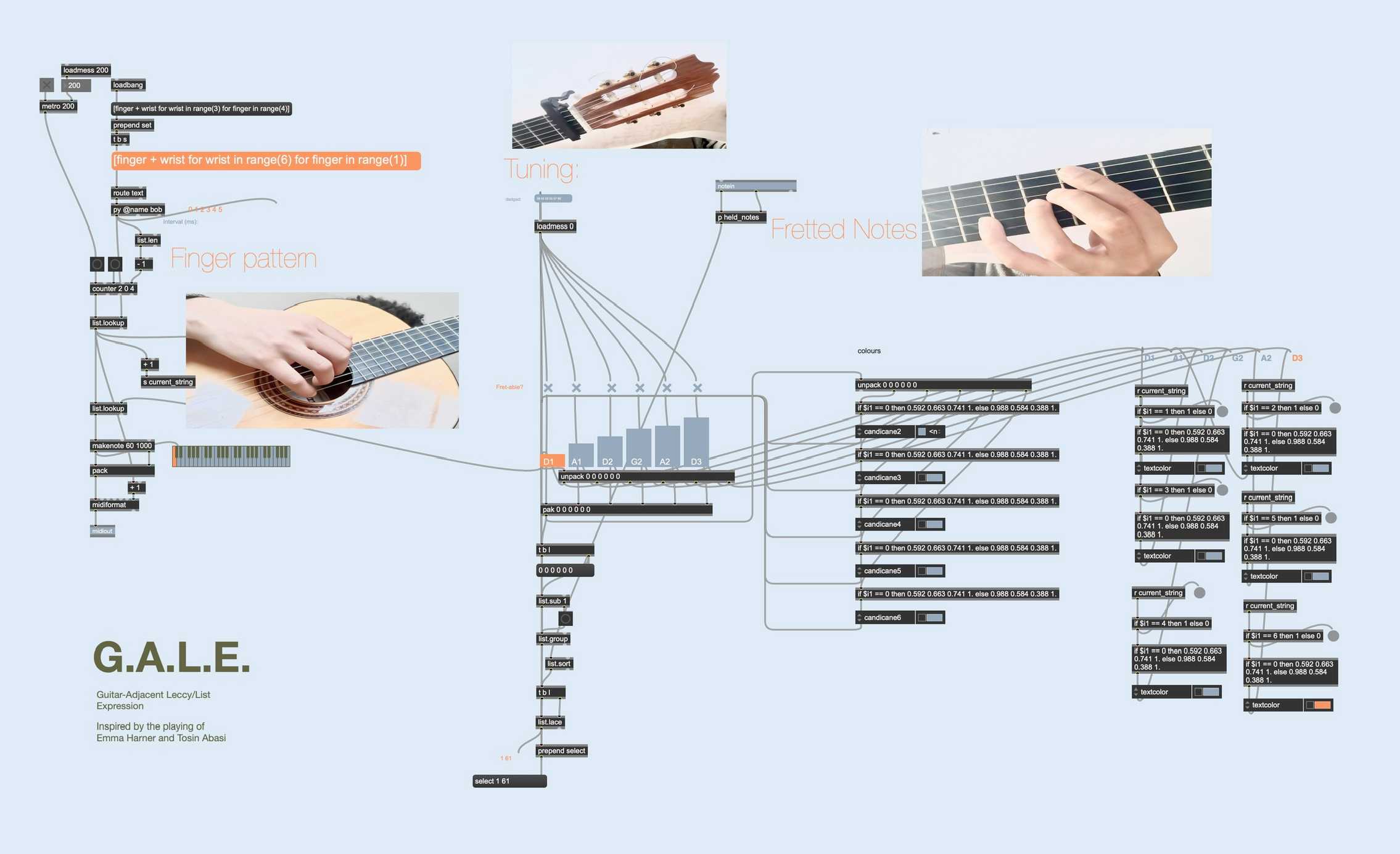
You can choose the pitch of open strings in the interface, then fret the rest via MIDI1. The picking pattern is generated from the list comprehension 2 sent into a python object. The right hand speed is controlled by a little metro object. Finally, each “string” is then routed to its own MIDI channel in Ableton, for per-string monophony and panning. It'd be interesting to map each finger to velocity too (eg, a thumb plucks heavier than a ring finger), but I haven't done that yet.
The full patch can be found on GitHub
Thoughts
I like the ‘picking-as-sequencing’ and 'open string + frets' ideas, for computer music which is inspired by the guitar, as well as guitar music which is inspired by algorithms. I reckon there is some potential to strike a nice balance between playability (using midi for fretted notes) and complexity (list comprehension can get gnarly verrrry quickly). I'll update this page with any revelations as I explore further!